
Custom Implant Abutment Dental Laboratory
Custom implant abutments at The Art of Aesthetics are designed to achieve precise fit, accurate margins, and optimal emergence profile for implant-supported restorations. Each case is developed based on the clinical requirements, including tissue condition, implant position, and restorative design. Abutments are engineered to support proper soft tissue contour while maintaining cleansability and long-term stability. Attention is given to margin placement, angulation, and interface accuracy to ensure seamless integration with the implant system. Whether used for single-unit crowns or complex restorative cases, the objective is consistent—provide a stable foundation that supports function, esthetics, and predictable clinical outcomes with minimal chairside adjustment.
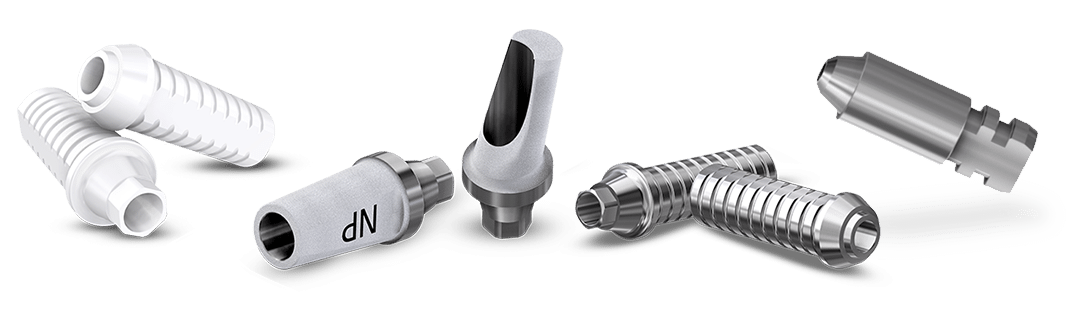
Implant Systems and Genuine Components
For faster turnaround time and consistent reliability, in-house production is the preferred approach. Certified genuine components are utilized to ensure precise interface compatibility, predictable fit, and alignment with manufacturer specifications.
In-House Production Utilizing Genuine Parts
Custom implant abutments are designed and fabricated in-house using genuine components to ensure precise interface compatibility and consistent fit. This approach allows control over accuracy, emergence profile, and restorative design while maintaining alignment with manufacturer specifications.
Straumann™ Implant Systems
Custom abutments for Straumann systems are developed with attention to connection precision, margin placement, and emergence profile. Each case is designed to integrate seamlessly with Straumann components while supporting stable and predictable restorative outcomes.
Nobel™ Biocare Implant Systems
Custom abutments are designed to match Nobel Biocare interfaces with accurate seating and controlled angulation. Emphasis is placed on achieving proper margin position and soft tissue support for consistent restorative performance.
ZimVie™ Implant Systems
Custom abutments for ZimVie systems are developed to ensure compatibility, fit accuracy, and proper load distribution. Each design supports functional stability and integration within implant-supported restorations.
Azure™ Implant Systems
Custom abutments for Azure™ systems are developed with precise interface alignment and controlled emergence profile. Each case is designed to ensure accurate seating, margin integrity, and reliable integration within implant-supported restorations.
Atlantis™ Custom Abutments
Atlantis custom abutments are supported with accurate interface compatibility, controlled margin placement, and consistent fit for implant-supported restorations. Used as needed, they provide reliable integration within a range of clinical situations.
Emergence Profile and Soft Tissue Management
Emergence profile and soft tissue management are critical in custom implant abutment design. Each abutment is developed to support natural tissue contour while maintaining cleansability and biologic stability. Proper emergence profile helps guide soft tissue healing, supports papilla formation, and contributes to esthetic integration, particularly in anterior regions. Margin placement is carefully controlled based on tissue condition and restorative requirements to avoid excessive subgingival depth while preserving esthetics. Abutment contour is designed to balance tissue support with hygiene access, reducing the risk of inflammation and long-term complications. Implant position and angulation are also considered to ensure the final restoration integrates naturally with surrounding structures. The objective is to create a stable and predictable foundation that supports both soft tissue health and restorative success across a wide range of implant cases.
Margin Placement and Interface Accuracy
Margin placement and interface accuracy are fundamental in custom implant abutment design. Each abutment is developed to achieve precise seating at the implant interface while maintaining controlled margin positioning relative to the soft tissue. Proper margin placement supports esthetics without creating excessive subgingival depth that may compromise hygiene or tissue health. Interface accuracy ensures a stable connection between the implant and abutment, reducing the risk of micromovement or mechanical complications. Angulation and path of insertion are also evaluated to align with restorative requirements and crown design. Attention to these factors allows the final restoration to seat accurately and function predictably. The objective is to create a stable and precise connection that supports both biologic and mechanical performance across implant-supported restorations.
Angulation Control and Restorative Alignment
Implant angulation often presents challenges in restorative cases, requiring precise control at the abutment level. Custom implant abutments are designed to correct angulation and establish an ideal path of insertion for the final restoration. This allows for proper crown positioning, improved esthetics, and functional occlusion. Angulation correction also helps reduce stress on restorative components by aligning forces along the implant axis. Each case is evaluated to determine the appropriate degree of correction while maintaining structural integrity and interface accuracy. Proper alignment supports predictable seating, improved retention, and reduced chairside adjustment. The goal is to create a restoration that integrates naturally within the occlusal scheme while compensating for implant positioning limitations in a controlled and clinically appropriate manner.
Material Selection for Custom Abutments
Material selection plays a key role in the performance of custom implant abutments. Titanium is commonly used for its strength, durability, and reliable interface compatibility, particularly in posterior or high-load cases. Zirconia may be selected in esthetic regions where soft tissue shading and translucency are important. Each material is chosen based on clinical requirements, including implant location, occlusal load, and esthetic demand. Consideration is also given to long-term stability, wear resistance, and compatibility with the final restoration. Proper material selection ensures that the abutment provides a stable foundation while supporting both functional and esthetic outcomes. The objective is to balance strength, precision, and clinical performance without introducing unnecessary complexity.
Case Submission and Workflow
Submitting a case to The Art of Aesthetics Implant Dental Laboratory is structured for clarity and efficiency. Cases may be submitted through intraoral scanning systems or by sending conventional impressions with a detailed prescription, including implant system, tissue condition, and restorative objectives. Each case is reviewed prior to fabrication to ensure compatibility and alignment with clinical requirements. Communication is direct and focused, allowing adjustments and preferences to be incorporated early in the process. For new clients, starting with a single case is recommended to evaluate fit, emergence profile, and overall consistency. This initial step establishes workflow alignment and expectations. The objective is to provide a streamlined process that delivers predictable results with minimal chairside adjustment and reliable restorative outcomes.